
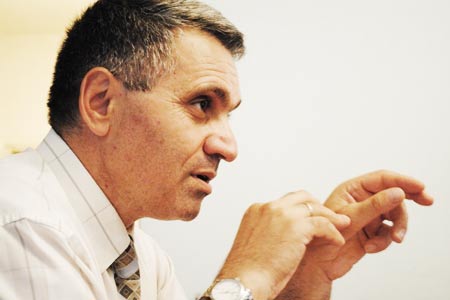
ArmInfo. Trump's stated goals for the military operation in Iran are unclear and inconsistent-this is certainly part of his character and management style. This is what national security expert and political scientist Hrachya Arzumanyan writes in her article.
According to him, the stated goal of the operation is currently regime change or overthrow in Iran. The means are the Air Force, and the means are a strategic air campaign to destroy leaders, forces, assets, and infrastructure.
However, the Air Force alone is not enough to force the IRGC and the armed forces to lay down their arms. And who is there to surrender to if the US doesn't intend to occupy Iran-and they don't, since that's impossible? Who can guarantee the lives and immunity of IRGC personnel if the regime collapses? Who in Iran has the military resources to fulfill such guarantees? "Rhetorical questions," the political scientist believes. Moreover, he notes, the US is not offering the Iranian people the means or means to revolt and seize power in Iran. The regime is deeply rooted, and beheading the top leadership will not overthrow it. This is especially true given the lack of an organized resistance movement within Iran that could take advantage of the temporary chaos caused by the assassination of its leaders.
"I think Trump will soon tell the Iranians that the US has done its part to overthrow the regime, and Iranian society must do its part. If it doesn't work, Iranian society is to blame. Trump's speeches already suggest the kind of tone that will later allow him to blame the Iranian people for failing to take advantage of his massive, brilliant air campaign," Arzumanyan writes.
Arzumanyan makes the following important points. First, as recent conflicts have shown, the consequences often prove larger-scale, unexpected, and far-reaching than anticipated, extending beyond the immediate conflict: "So far, I see a Libyan scenario, but on a much larger scale." Second, it further weakens any meaningful international rule of law. The US is clearly violating international law. This includes violating US law: "Trump started the war without even consulting Congress, which is supposed to authorize the war. Given Congress's docility, I think Trump will get the authorization, but only after the fact, demonstrating his absolute power."
But can it all end well, Arzumanyan asks. "I don't think so. US goals are inconsistent with the means and methods, leaving a huge question mark the day after the airstrikes cease. I've seen time and again how carefully laid plans collapse, leading to unforeseen consequences. In the ongoing Iran war, the US, unlike Israel, simply doesn't seem to have a plan for the next day," the political scientist writes. "Israel's goals are clear and precise - the collapse of Iran, preferably with the disintegration of the country." In this sense, one can speak of a clear asymmetry in American-Israeli relations, with Israel in the lead and the United States the follower.
























 Expert: Current process is not about peace, but implementing Azerbaijan`s wishlist
 Expert: Real peace unattainable until Armenia-Azerbaijan agreement is signed and ratified
 TRIPP`s proximity to Iranian border could slow its implementation - expert
  Who and why is sacrificing RA National Security Service`s reputation? - expert
  Tehran creating security environment in which sustainable shipping in Strait of Hormuz difficult to imagine without its direct participation - expert
  Arrested Armenian oligarch on economy and new jobs
  NA Vice Speaker candidate believes his wife`s salary as director of HayPost is the lowest in the company`s history
 RF Permanent Representative: There is no CSTO-Armenia conflict
 Moscow: NATO seeking to "Pull" Armenia away from CSTO Allies
  Political analyst: Russia intends to determine which "Camp" Armenia will choose through a referendum
 Narek Karapetyan will give up his parliamentary salary in favor of charitable contributions.
 Armenian analyst: Developing relations with Europe and the U.S. must not jeopardize relations with regional powers
 Armenia and France discuss further development of strategic partnership and EU cooperation
  To overcome risks Armenia must reduce domestic escalation - expert
  Zatulin: Pashinyan was eager to get back to Russia because he actually lost the elections
 Human rights activist Ruben Melikyan dismissed from YSU
 Pashinyan removed from INNOPROM guest list
 Zakharova: Armenia`s pro-EU pivot poses economic security risks to EAEU member states
 It`s time for South Caucasus countries to think of South Caucasus as single, unified region - RA premier
  Pashinyan: Armenia and Azerbaijan should leave each other alone