
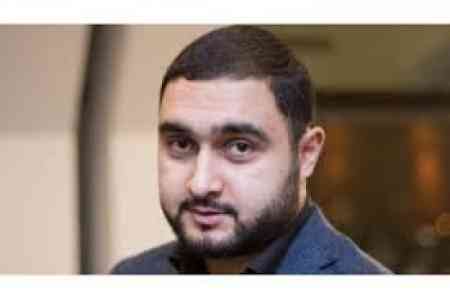
ArmInfo. "According to well-known and experienced economists, the program presented by the "In Our Way" movement is ambitious, yet realistic and well- thought-out," Tigran Dumikyan writes.
The analyst recalled that Narek Karapetyan, the movement's coordinator, presented to the public the economic and social program that the political force initiated by Samvel Karapetyan intends to implement. A central pillar of the program is the revitalization of the industrial sector, with a goal to create approximately 300,000 new jobs in Armenia. For the current government, this goal could be classified as science fiction, as the investments made in Armenia's industrial sector over the past eight years have been largely financed by Samvel Karapetyan's own private funds. Meanwhile, long-term, sustainable development is only possible through strengthening the real economy, particularly industry, and not through artificial growth in the service sector.
The second stage of the program, Dumikyan continued, is truly revolutionary for small businesses: it involves freeing them from the tax burden. This approach may naturally seem incomprehensible to the authorities, who pursue a policy of treating citizens as "material for fines" and managing the economy through administrative pressure. However, the analyst believes that the state's priorities should be effective social policy, improving the quality of life for citizens, and creating a healthy business environment, rather than distributing billions of drams within the public system by increasing foreign debt.
The next key component of the economic program concerns agriculture. The movement proposes to address one of the most pressing issues facing the rural economy by introducing a guaranteed procurement system. This could usher in a qualitatively new stage in the development of villages and agriculture in the history of independent Armenia. " For many years, various governments have avoided providing real support for the economic activity of the rural population, resulting in a complex and stagnant socioeconomic picture in the regions, especially rural communities," Dumikyan noted.
He emphasized that, in parallel with the economic program, Narek Karapetyan has also presented two major social initiatives. The first concerns a significant reduction in medication prices. The state, drawing on the experience of Georgia and several other countries, can use appropriate tools to ensure access to medications for a wide range of the population. It is no secret that purchasing medications is a serious issue for thousands of citizens living in difficult social circumstances, and a systemic solution to it could significantly improve both social protection and the overall state of public health. The second social priority concerns housing affordability. This issue directly impacts the formation of young families, the birth rate, and demographic policy.
"Although the state has implemented various programs in recent years, they have been primarily localized or accessible to a limited number of people. Samvel Karapetyan's team states that if it comes to power, it plans to build approximately 20,000 new apartments for young and large families and provide them on affordable terms. This is only the first stage of a program that is planned to be included in the government's long-term strategy in the future, setting new standards for the next five years.
Thus, the "In Our Way" movement presents five clear steps aimed at removing the current government through national elections and building a strong, economically self-sufficient, and socially just Armenia. How the public will react to the program proposed by Samvel Karapetyan will become clear in the near future. However, one thing is clear: the current government continues to make promises to the people, the viability of which has been repeatedly undermined over the past eight years," the analyst noted.














 RA Government guarantees high salaries for CC justices, Syunik families deprived of family benefits - politician
  Armenian experts, leading Turkish think tanks discuss prospects for expanding cooperation
  Political Scientist: As long as the opposition remains silent, Pashinyan can use Plan B and secure a constitutional majority
 Zakharova: Armenia`s pro-EU pivot poses economic security risks to EAEU member states
 It`s time for South Caucasus countries to think of South Caucasus as single, unified region - RA premier
  Pashinyan: Armenia and Azerbaijan should leave each other alone
 Moscow sees situation with Armenia as attempt to attack Russia-involving integration associations - Russian presidential aid
 Zakharova: Armenia views relations with Russia as tool for financially securing reorientation toward EU
 The Armenian Minister of Justice and the EU Ambassador discussed visa liberalization issues for Yerevan.
 Azerbaijan`s aggressive plans against Armenia became possible in wake of Pashinyan`s decisions on Artsakh - expert
  Zakharova: Russia sent a note of protest to Armenia over the act of vandalism at the "Mother Armenia" memorial in Gyumri
 Samvel Karapetyan proposes creating a post-election opposition coalition
 Artsakh`s Cultural Heritage Ombudsman called on Moscow to respond to destruction of WWII monuments by Azerbaijan in occupied NKR
 Dutch Prime Minister expresses his support for Armenia`s democratic reform and economic diversification agenda
 Heritage: It`s time for Armenia`s opposition to present people with legitimate alternative to power
 RA Security Council Sec, Assistant to President of Azerbaijan hold negotiations in Dilijan