

ArmInfo.The election of Azerbaijan to the UNESCO Committee for the Protection of Cultural Property in Armed Conflicts for 2025-2029 is a mockery of the idea of protecting cultural heritage, given the crimes committed by the Azerbaijani side against Armenian Christian heritage, as noted in a statement issued by the Artsakh Cultural Heritage Ombudsman following the results of the 16th Meeting of States Parties to the Second Protocol to the 1954 Hague Convention held on December 1 and 2.
"Azerbaijan has secured a place in a structure intended to protect cultural heritage, not serve as a platform for the political self-legitimization of states with a genocidal past. However, this is where the main paradox and the main cynicism begins. Over the years of military campaigns against Artsakh, one of the systematic, obvious, and documented targets of the Azerbaijani armed forces has been the region's cultural heritage," the Artsakh Cultural Ombudsman recalled.
He noted that this concerns not only territories, infrastructure, and the lives of civilians, but also churches, monasteries, cemeteries, and historical sites, many of which have a millennia-long history and belong to a unique Armenian cultural heritage.
In this regard, he noted that UNESCO, an organization obligated to be an arbiter and moral guide in matters of cultural heritage protection, is taking a step that undermines its own principles. Indeed, as the Ombudsman noted, instead of demanding independent investigations into the destruction committed in Artsakh, UNESCO is effectively handing Azerbaijan a mandate of trust, as if nothing had happened, and there were no broken crosses, destroyed khachkars, or vanished cultural monuments.
However, he expressed the conviction that memory cannot be rewritten, as cultural heritage is not a decorative value or diplomatic coin, but the roots of a people, its spiritual territory, its history, and its right to exist.
"And that is precisely why Azerbaijan's election as a member of the UNESCO Committee seems emblematic of an era where politics is more important than truth, and international structures are willing to sacrifice principles for the sake of futile 'balancing acts,'" the Artsakh Cultural Heritage Ombudsman concluded.










 Present-day geopolitical competition shifts from territorial control to infrastructure flows
 Expert: Public participation in decision-making essential for sustainable urban development
  Politician: Statement by Armenia`s third president may deprive opposition of only political basis for ousting Pashinyan
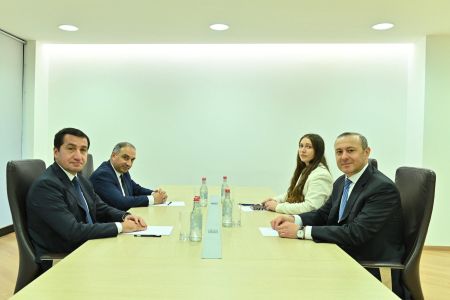 RA Security Council Sec, Assistant to President of Azerbaijan hold negotiations in Dilijan
  CEC Neutralizes PAP: Three Political Forces to Enter Armenian Parliament Following Election Vote
 Elections in Armenia were accompanied by unprecedented pressure on opposition, RF MFA spokesperson claims
  Expert: Even OSCE observers recorded numerous violations during elections in Armenia
  Moscow to await official results of Armenian elections - Peskov
 Antonio Costa: EU to deepen its partnership with Armenia, expanding cooperation in energy, trade, and digitalization
 Israeli MFA congratulates Pashinyan
 Turkish MFA comments on results of Armenian elections
  Zakharova: International observers cannot ignore `flagrant violations` in Armenian elections
 Russian Senator: Opposition complaints regarding election violations by ruling party remain unanswered
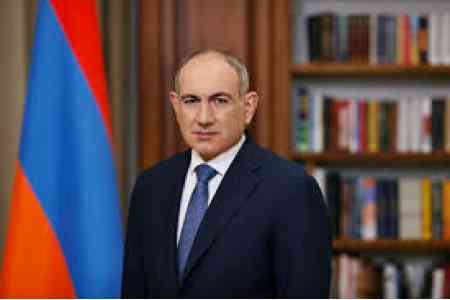 RA premier receiving congratulations on his victory in parliamentary elections
 Head of IPA CIS Council Secretariat: Extremely difficult atmosphere during parliamentary elections campaign in Armenia accompanied by mass arrests
 Pashinyan`s party leads with 51.13% based on vote counts from 533 polling stations