

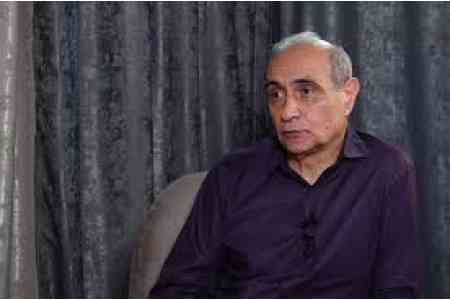
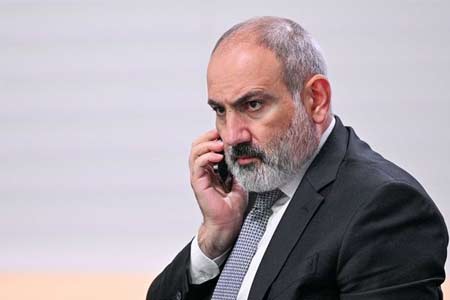
ArmInfo. The duration of military service should be determined by assessing the risks of potential enemy aggression and the need to defend the state now and in the near future. Military expert Hayk Nahapetyan expressed this opinion in an interview with an ArmInfo correspondent, commenting on Prime Minister Nikol Pashinyan's announcement to reduce the duration of mandatory military service in Armenia from 24 to 18 months starting next year.
According to the expert, the size of the army is determined based on the challenges facing the country, whether from neighboring or distant countries, and also to neutralize threats if necessary. In other words, as Nahapetyan clarified, the size of the army is not a voluntary decision. To illustrate this, the expert cited the situation in Israel in 1948 as an example. "At that time, Israel, with a small population, was blockaded by Arab states, which had begun military operations. To effectively counter the enemy, Israel's military leadership began conscripting men for eight years and women for six. That is, the length of military service was determined based on the challenges facing the state and the need to counter any potential aggression," Nahapetyan stated.
The expert pointed out that currently, Armenia and Azerbaijan are in a state of undeclared war, as the two countries legislative bodies have not ratified any legal act confirming the declaration of peace between the states. "Azerbaijan is increasing military spending on offensive weapons. For example, a few days ago, they purchased fourth-generation fighter jets from Pakistan, which have already proven their effectiveness in combat situations in India and Afghanistan," the expert emphasized.
He also mentioned that military exercises involving tank forces from Turkey, Georgia, and Azerbaijan had taken place just days before. "Additionally, Azerbaijan has increased its military personnel, currently totaling 100,000. And within 72 hours, they can replenish their reserve military units, to which approximately 80,000 reservists are assigned, with approximately the same number of conscripts. In other words, Azerbaijan, despite having a significant military reserve, continues to utilize conscription for their reserve units," Nahapetyan noted.
Meanwhile, the expert recalled that not only is the length of military service being shortened in Armenia, but the size of the army and its military expenditures in the state budget, are also being reduced. Addressing the authorities' statements about replacing them with contract soldiers, he recalled that their conscription began in the 1990s due to a shortage of conscripts.
"Back then, conscription for combat service was carried out among war veterans or citizens with military experience and adequate health. However, it must be understood that for contract military personnel, this is not service, but work. Therefore such service members should at least be provided with a social package. Meanwhile, the current government has not said a word about this," the expert noted.
He expressed confidence that such an attitude will lead to a reduction in the number of contract soldiers. In other words, as Nahapetyan noted, the Armenian authorities have not only shortened the duration of military service but have also taken no steps to increase the number of contract soldiers. "Ultimately, as a result, a point will come when the Armenian army's military personnel will be significantly fewer than Azerbaijan's. And without a signed peace treaty, Azerbaijan's threat of force will become more effective. This means that Armenia will be forced to make concessions to Azerbaijan given their military's superiority," the expert explained.
Regarding the main reason for the reduction in military service, Nahapetyan expressed his belief that this is a pre-election move, recalling that the decision was initially supposed to take effect in June 2026. However, it was postponed until January 1. The expert noted that this is precisely the period when the winter draft will begin, and further suggested that the reduction in military service could be extended and shortened by another six months before the June 2026 elections. "The authorities will justify this decision by citing peace with Azerbaijan and the pointlessness of a longer term. In other words, another reduction will be used as an election tool. However, it must be understood that the Prime Minister's attempt to convince everyone that a 'piece of paper' signed in Washington guarantees peace is nothing special," the expert noted.
In support of his words, he recalled that a similar agreement, brokered by four countries-the United States, Turkey, Qatar, and Egypt-was signed on October 10 in Sharm el-Sheikh, establishing a ceasefire between Israel and Hamas. "However, this was done without the presence of the main parties to this conflict. This document entered into force on October 13, but on October 19, Israel again attacked civilians in the Gaza Strip, launching approximately 120 aerial bombs. This is the real price of US mediation," Nahapetyan emphasized. In conclusion, the expert expressed his conviction that the solution lies in an adequate assessment of the situation in Armenia. "Today, the main issue is that many political parties and expert circles do not share the same assessment of the situation. That is, there is no consolidation around a single idea or a unified position on resolving existing challenges and threats," the military expert concluded.



















 Political Scientist: As long as the opposition remains silent, Pashinyan can use Plan B and secure a constitutional majority
 US-Iranian memorandum more beneficial for Iran from political and economic perspective - expert
  Political analyst: While Pashinyan pledges peace with Azerbaijan, Baku continues promoting the "Western Azerbaijan" project
 Political analyst: In light of new realities, Yerevan may propose advancing peace process with Baku without constitutional referendum
 Present-day geopolitical competition shifts from territorial control to infrastructure flows
 Artsakh`s Cultural Heritage Ombudsman called on Moscow to respond to destruction of WWII monuments by Azerbaijan in occupied NKR
 Prosecutor General`s Office petitions Central Electoral Commission for criminal prosecution of Robert Kocharyan
 Dutch Prime Minister expresses his support for Armenia`s democratic reform and economic diversification agenda
 Heritage: It`s time for Armenia`s opposition to present people with legitimate alternative to power
 RA Security Council Sec, Assistant to President of Azerbaijan hold negotiations in Dilijan
  CEC Neutralizes PAP: Three Political Forces to Enter Armenian Parliament Following Election Vote
 Elections in Armenia were accompanied by unprecedented pressure on opposition, RF MFA spokesperson claims
  Expert: Even OSCE observers recorded numerous violations during elections in Armenia
  Moscow to await official results of Armenian elections - Peskov
 Antonio Costa: EU to deepen its partnership with Armenia, expanding cooperation in energy, trade, and digitalization
 Israeli MFA congratulates Pashinyan
 Turkish MFA comments on results of Armenian elections
  Zakharova: International observers cannot ignore `flagrant violations` in Armenian elections