

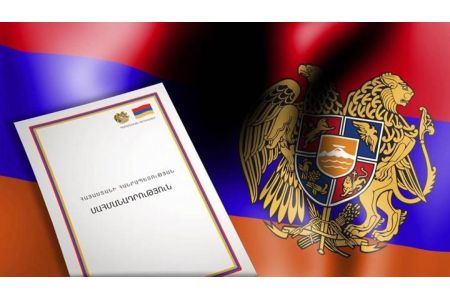
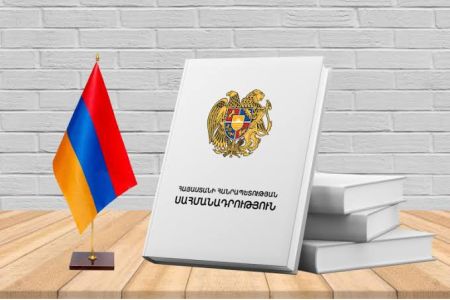
ArmInfo. The draft of Armenia’s new Constitution provides for sweeping changes to the wording defining the foundations of Armenian statehood and relations between the state and the Armenian Apostolic Holy Church (AAC). The declaration of independence, which mentioned Nagorno-Karabakh and the international recognition of the Armenian Genocide in the Ottoman Empire, has been removed from the country’s fundamental law.
Thus, in the revised Constitution presented by Armenia’s Ministry of Justice, the emphasis is placed on the people of the Republic of Armenia, its internationally recognized territory, independence, security and continuity of the state.
Meanwhile, the Declaration of Independence of Armenia, adopted on 23 August 1990 by the Supreme Council of the Armenian SSR, states that the document was adopted, among other things, on the basis of the joint decision of the Supreme Council of the Armenian SSR and the National Council of Nagorno-Karabakh of 1 December 1989, “On the Reunification of the Armenian SSR and Nagorno-Karabakh.” Paragraph 11 enshrines the provision that Armenia supports the international recognition of the 1915 Armenian Genocide in Ottoman Turkey and Western Armenia.
It is noteworthy that these are precisely the provisions whose removal from Armenia’s Constitution Azerbaijan and Turkey had sought. And although the revised version retains a mention of the exclusive mission of the AAC, it changes the legislative regulation of relations between the state and the Church, which is now formulated as mandatory. In particular, instead of the wording “relations between the Church and the state may be regulated by law,” it now states that they “are regulated by law.”
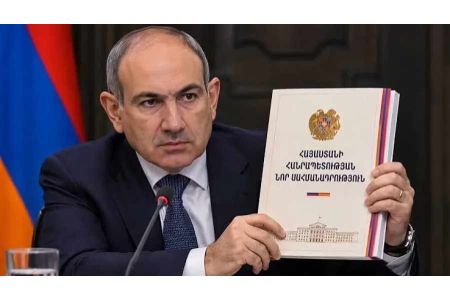
It should be noted that on the morning of 23 November, Armenian Prime Minister Nikol Pashinyan announced that the draft of Armenia’s new Constitution had already been published on a website specially created for this purpose. He subsequently also addressed the citizens of the Republic in a live broadcast. The draft of the country’s new fundamental law can be viewed by following the link https://yourconstitution.am/hy.
It should be recalled that, following the regular parliamentary elections held in Armenia on 7 June 2026, the Civil Contract party has a 3/5 majority, which allows it to adopt constitutional laws and make appointments, but the party does not have the 2/3 majority of votes required to introduce direct amendments to Armenia’s Constitution. It should also be added that, following the occupation of Artsakh, demands from Baku for Armenia to change its Constitution have frequently been voiced on the grounds that it allegedly contains territorial claims against Azerbaijan. The Azerbaijani side presents fulfillment of these and other demands as a precondition for concluding a “peace treaty.”
























 A security sphere expert commented on a video about Papikyan`s achievements during his five years as Defense Minister
 The future of the South Caucasus was discussed in the capital of a country whose problem remains unresolved — Davtyan
 An Armenian orientalist presented possible US actions against Iran
 Expert: Official Yerevan should not base its calculations in relations with Ankara on the "crack" in the Turkish-Azerbaijani alliance
 Armenia and Germany held consultations on defense issues
 Armenia wants to host COP-34 in 2029
 Speaker: Armenia has never approached the CSTO regarding the Karabakh issue
 Lavrov: Armenia will not be expelled from the CSTO
 Drmeyan: The ECHR rejected Azerbaijan`s appeal in the case of Artsakh Defense Army Major Hayk Toroyan
 "Strong Armenia": The brawl in parliament was staged to distract public attention from Pashinyan`s failed foreign policy
 Zakharova commented on the scandalous epithets of the governor of Armenia`s Shirak region about "Ivanov"
 Nikolai Bordyuzha proposed excluding Armenia from the CSTO.
 The participation of Artsakh ensembles in an international festival in Vienna was cancelled following the intervention of several foreign embassies
 Expert: It`s time for Armenia to move away from uncertainty and choose between West and East
 The Armenian Foreign Minister commented on the country`s return to work within the CSTO.
 The Artsakh Public Council expressed outrage at the UN Secretary-General`s behavior
 Lukashenko called for Armenia to assume the CIS presidency in 2029
 Dmitry Medvedev predicted a Ukrainian-like fate for Armenia amid the country`s shift in foreign policy
 Russian Security Council: In Armenia, they want to force Russian asset owners to dispose of their assets