

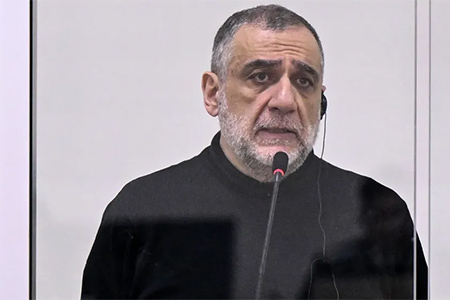
Arminfo. Philanthropist and former Artsakh State Minister Ruben Vardanyan called on Azerbaijan’s Human Rights Commissioner Sabina Aliyeva to meet with Armenian prisoners of war and respond to their appeals.
In a statement circulated by Vardanyan’s family, it is noted that the philanthropist recorded his public appeal to Azerbaijan’s Human Rights Commissioner on September 16, 2026, after she stated her readiness to assist with issues concerning respect for the rights of convicted Armenian citizens. In it, the former Artsakh State Minister refers to the Penitentiary Code and a brochure on the rights of convicts, which the Commissioner’s office handed to prisoners in April of this year, and emphasizes that these rights must be respected regardless of the article of indictment, nationality, religion, or citizenship.
"I and 18 other compatriots of mine, convicted to various terms, are being held at the Umbaki penitentiary institution and, I am forced to state, are facing constant violations of our rights as convicts, which are defined by your legislation regardless of the article under which a person was convicted, their nationality, religion, or citizenship. Before moving on to the violations, I want to tell you once again that the hotline mechanism by telephone at 916 does not work. I was given the right to call this number only once, and that was on June 19. But there has still been no response from your office. My lawyer also left you a message, but again there was no response. We were told in response that you have 20,000 prisoners, and that you would visit us when you had time. But this means that the hotline is an imitation; it does not work," the philanthropist points out.
Vardanyan went on to point to the absence of weekly telephone calls for some prisoners and the unavailability of video calls, due to which some have not seen their children for almost three years. "Not all of the 19 convicts have the right to make a call. As for the right to a video call, it is stipulated in Article 84.1 of Azerbaijan’s Penitentiary Code. Moreover, Article 81.1 states that, at the request of a convict or for other reasons, short-term visits to which we are entitled may be replaced by video calls. I want to say once again that for more than three years, many of those here—and for some, it will soon be three years—have been unable to communicate even with their children. My cellmate’s child was ten months old when he was detained, and is now more than three and a half years old, which means that this child has not even seen his father. I believe this is a gross violation of the right to the possibility of elementary contact with one’s children," the former Artsakh State Minister stated.
In addition, Vardanyan pointed to the inability to undergo medical tests even at one’s own expense, the inability to issue a power of attorney for relatives due to the refusal to provide notarial services, the restriction of physical exercise to 20–40 minutes once a week instead of the prescribed one hour a day, and the lack of written responses to applications and complaints. He separately speaks about the fact that after the International Committee of the Red Cross (ICRC) ceased operating in Azerbaijan, prisoners lost a channel of communication with their families. "Finally, and most importantly: the right, on personal matters, to contact diplomatic missions of their states or international organizations that have taken responsibility for the welfare of convicts. Unfortunately, after the Azerbaijani leadership closed the ICRC office, since June 2025 we have been unable to receive through them information from our families, belongings, clothing, food, photographs, letters, and other items. Their visit in December 2025 was very brief and formal, and they were not permitted to give us anything," Vardanyan said.
He also recalls the initiative of his wife, Veronika Zonabend, who was ready to come to Baku and meet with the Human Rights Commissioner and Armenian prisoners of war. "Unfortunately, despite the preliminary peace agreement signed on August 8, 2025, and numerous contacts between representatives of the two countries, this issue has still not been resolved. I am sorry that you did not find the opportunity or time to respond to the public appeal of my wife, a Russian citizen, who was ready to come together with several other people and bring with her more than a thousand letters written by the 19 convicts, parcels, and other things that are so necessary, and, most importantly, to support their ability in this situation to maintain a normal way of life. You did not even propose an alternative solution," the former Artsakh State Minister noted.
In light of the above, he asked the Commissioner to meet with the Armenian prisoners and respond to their appeal. "I am confident that resolving all these issues does not require the direct intervention of the republic’s top leadership and will only contribute to improving relations between our two peoples, despite the difficult past and the enormous burden of mutual grievances. No matter how much longer we spend in Umbaki, please comply with your own laws. It seems to me that this is right not only for us, but for Azerbaijani society as a whole. I am convinced that you can resolve these problems," Vardanyan concluded.
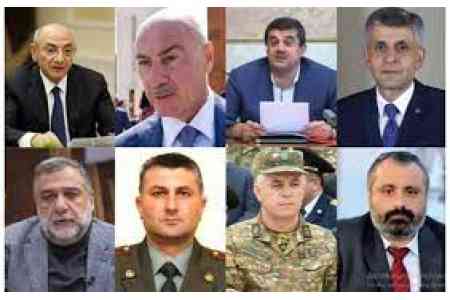
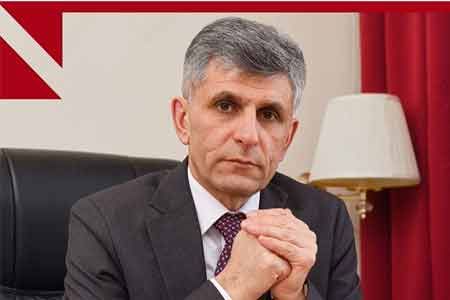
It should be noted that the exact number of Armenian prisoners of war and hostages held in Azerbaijani prisons remains unknown. Experts estimate that there are several hundred of them. Today, the Azerbaijani authorities confirm that they are holding 19 Armenians. Among those held in Azerbaijani captivity are eight former and current representatives of Artsakh’s military-political leadership. They include former Artsakh presidents Arkady Ghukasyan, Bako Sahakyan, and Arayik Harutyunyan; former Foreign Minister David Babayan; Parliamentary Speaker David Ishkhanyan; former commander of the Artsakh Defense Army, General Levon Mnatsakanyan; General David Manukyan; and former State Minister Ruben Vardanyan.
In February, a puppet court in Baku sentenced Arayik Harutyunyan, David Babayan, David Ishkhanyan, David Manukyan, and Levon Mnatsakanyan to life imprisonment on fabricated charges, while Bako Sahakyan, Arkady Ghukasyan, and Ruben Vardanyan were sentenced to 20 years in prison. The so-called court sentenced the remaining Artsakh residents to up to 15 years in prison.













 Armenian Historian: People Like Magdalena Grono Should Be Kept Away from the Thresholds of Armenian Shrines
 Azerbaijani studies expert: Armenia’s Foreign Ministry could use the ICC against Aliyev’s Armenophobic statements
 An Armenian political analyst exposed Hajiyev’s lies and attempts to mislead diplomats accredited in Azerbaijan in occupied Artsakh
 Expert: The circus surrounding the “Albanization” of Armenian culture in the presence of foreign ambassadors in occupied Artsakh is genocide
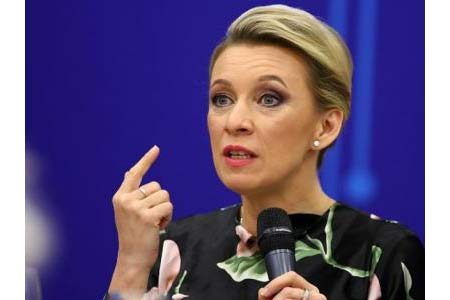 Zakharova: Russia ready to discuss with Armenia the prospects for expanding military cooperation as part of a review of bilateral ties
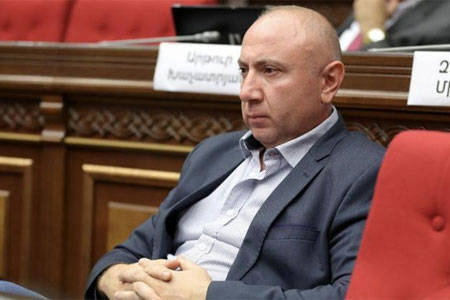 Tevanyan: Armenia, like Ukraine and Moldova, is being drawn into the EU’s global war
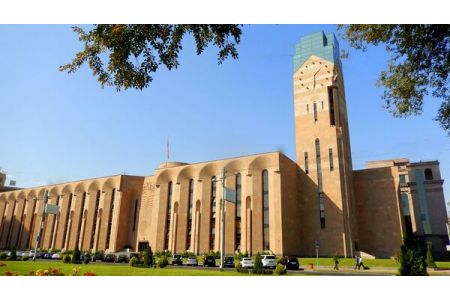 Yerevan City Hall is considering introducing a valet parking system in the city
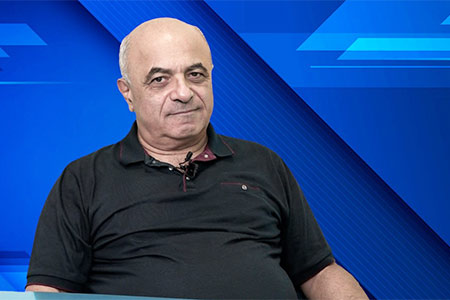 Political scientist: If Russian-Armenian relations are destroyed, Turkey will take Russia`s place
 Political scientist: The Armenian public is simply obliged to significantly change the entire content of public discourse and struggle
 Cross tattoos are being removed from the skin of Christian prisoners in Azerbaijan by fire, according to a human rights activist.
 Zakharova: Armenia`s likely introduction of visas with Russia will be a step against Yerevan itself
 Putin: Armenia`s recognition of Karabakh as part of Azerbaijan in Prague has given Russia`s position on this issue an ambivalent character
 Putin: Armenia`s adoption of the law on EU accession means an announcement of its withdrawal from the Eurasian Economic Union
 Medvedev: Yerevan will never become an EU member, but it will permanently damage relations with the Eurasian Economic Union, including with Moscow.
 Aram Vardevanyan: Public demands solutions, not apology scandals in Parliament
 Arrested Armenian oligarch on economy and new jobs
  "In Baku, we gave a worthy rebuff to the false claims regarding the past and present of our people" – Former Artsakh Parliament Speaker from Baku captivity