


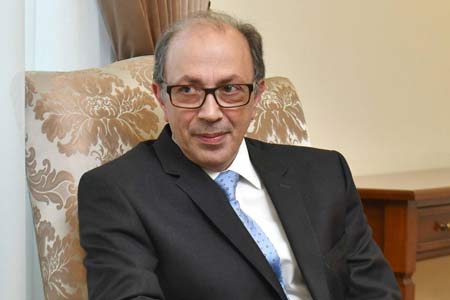
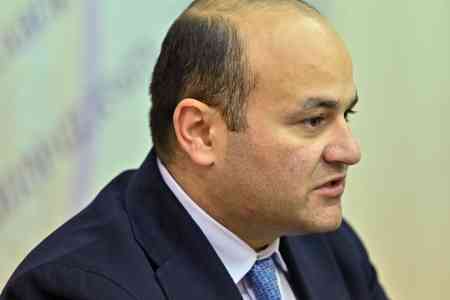
ArmInfo. When a political alternative is ousted from parliament, it's not the opposition that loses, but the system of checks and balances, democracy, and, ultimately, the state. In his new article, former Armenian Foreign Minister and founding member of the Pan-Armenian Council of Diplomats Ara Ayvazyan responded to the results of the Central Electoral Commission (CEC) recount, which resulted in the Prosperous Armenia Party (PAP) not gaining a seat in parliament.
According to Ayvazyan, the CEC's decision, which deprived the PAP of its parliamentary seat, will have serious consequences that will not be limited to the fate of just one political force. "It turns out that in today's Armenia, the citizens' will can be reconsidered by an administrative decision after the elections. And if a citizen is unsure whether their vote will influence the outcome, the legitimacy of the entire political system is at risk. In fact, it's not just one specific party that is being ousted from parliament. A political alternative is also being ousted in matters of foreign policy, security, and the future of Armenian statehood," reads an article published by the press service of the Alternative Projects group on Facebook.
According to the former minister, the campaign against the PAP has nothing to do with the authorities' false dichotomy between Russia and the West. Because, as Ayvazyan recalled, the PAP has always advocated for deepening relations and mutually beneficial cooperation with both Russia and the West. The real choice, he argued, was made between different models of security and development for the country. After all, as the expert recalled, the party has always advocated a balanced foreign policy based on cooperation with key international players. "We proceeded from the conviction that Armenia should not become a platform for geopolitical conflict, but rather a state capable of building realistic and mutually beneficial relations across all fronts, guided solely by national interests.
Of particular importance in this regard was the idea of guaranteeing peace by restoring the disturbed balance in the region. The Armenian diaspora is also an important component of our approach. Millions of Armenians living in various countries should serve as a bridge between Armenia and the countries in which they reside. For this reason, attempts to portray such a policy as an attempt to become an "outpost" of some force do not stand up to serious analysis," Ayvazyan noted.
The former Armenian Foreign Minister then recalled that democracy is one of the most effective forms of government not only because it gives citizens the opportunity to choose their government, but because security, justice, and stability are ensured by a balance between branches of government and state institutions. That is, as Ayvazyan explained, where independent institutions exist, power is limited by law, and where political competition exists, the likelihood of strategic mistakes is reduced. Meanwhile, in today's Armenia, he noted, a disturbing trend is observed, whereby the most important state decisions are made from a single political center.
"Parliament, the judiciary, and other institutions have lost their ability to act as a real counterweight to the executive branch. It is in this environment that decisions emerge that, just a few years ago, seemed impossible to implement. However, a strong state is not built on the monopoly of one political force or the indispensability of one policy. An effective state is built on the competition of ideas, the presence of diverse approaches to security and development, and the ability of society to democratically correct the government's mistakes," emphasized the founding member of the Pan-Armenian Council of Diplomats.
That is why, as Ayvazyan noted, the question is not so much about the election results, but about what Armenia will be like tomorrow. In other words, as the diplomat explained, the question now is between a state in which there is room for pluralism of opinions and in which different political forces can participate in decision-making, or a state in which the political system is becoming increasingly dependent on decisions made by a single center.
"History shows that democracy doesn't weaken only when elections are formally cancelled. It also weakens when superficial democratic procedures are observed, but political balance, competition, and real constraints on power gradually disappear. For this reason, today we're talking about more than just one party. We're talking about upholding the principles that ensure the stability of Armenian statehood. After all, when a political alternative is ousted from parliament, it's not the opposition that loses. The system of checks and balances fails. Democracy loses. And, ultimately, the state loses. At the same time, the Constitutional Court still has an exceptional chance to restore justice, but to do so, it must recognize these realities," Ayvazyan concluded.
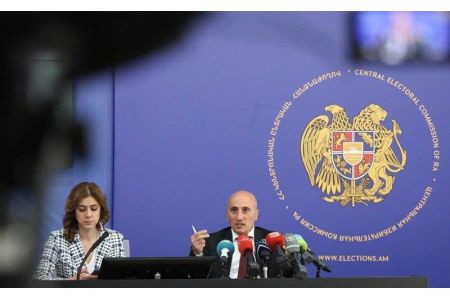
As a reminder, regular parliamentary elections were held in Armenia on June 7, 2026. On June 14, Central Election Commission Chairman Vahagn Hovakimyan presented the final results of the parliamentary elections. According to him, the Civil Contract Party won seats in the Armenian parliament with 49.7456% of the vote, Samvel Karapetyan's Strong Armenia bloc won 23.2710%, and second president Robert Kocharyan's Armenia bloc won 9.9231%. Gagik Tsarukyan's Prosperous Armenia Party failed to pass the 4% parliamentary threshold following a recount, receiving only 3.9893%.
Tsarukyan's party failed to pass the threshold after the Central Election Commission annulled the results of three polling stations where Tsarukyan's party received more than 200 votes. Thus, according to Hovakimyan, the mandates were distributed as follows: Pashinyan's party received 64 mandates, achieving a constitutional majority of 3/5 in parliament. Karpetyan's bloc received 29 mandates, and Kocharyan's bloc received 12 mandates. Thus, the Civil Contract party has a 3/5 majority, which allows it to pass constitutional laws and make appointments, but it lacks the 2/3 majority necessary to directly amend the Armenian Constitution.


























 Political analyst: While Pashinyan pledges peace with Azerbaijan, Baku continues promoting the "Western Azerbaijan" project
 Political analyst: In light of new realities, Yerevan may propose advancing peace process with Baku without constitutional referendum
 Present-day geopolitical competition shifts from territorial control to infrastructure flows
 Artsakh`s Cultural Heritage Ombudsman called on Moscow to respond to destruction of WWII monuments by Azerbaijan in occupied NKR
 Prosecutor General`s Office petitions Central Electoral Commission for criminal prosecution of Robert Kocharyan
 Dutch Prime Minister expresses his support for Armenia`s democratic reform and economic diversification agenda
 Heritage: It`s time for Armenia`s opposition to present people with legitimate alternative to power
 RA Security Council Sec, Assistant to President of Azerbaijan hold negotiations in Dilijan
  CEC Neutralizes PAP: Three Political Forces to Enter Armenian Parliament Following Election Vote
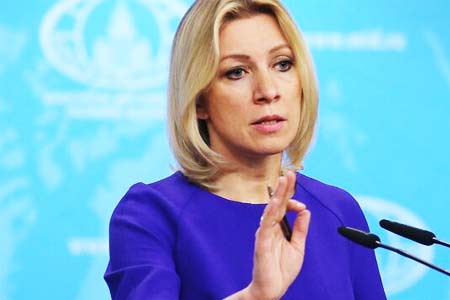 Elections in Armenia were accompanied by unprecedented pressure on opposition, RF MFA spokesperson claims
 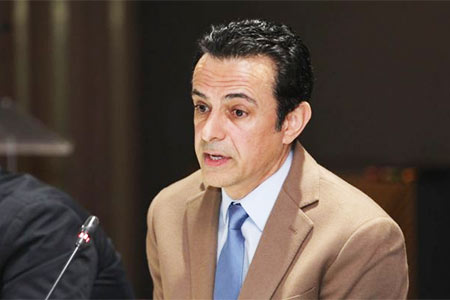 Expert: Even OSCE observers recorded numerous violations during elections in Armenia
  Moscow to await official results of Armenian elections - Peskov
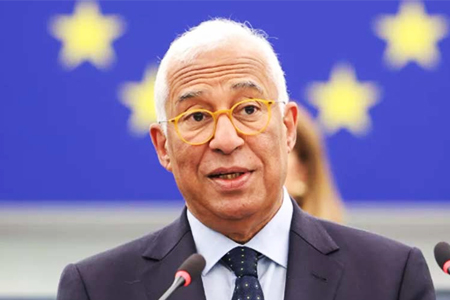 Antonio Costa: EU to deepen its partnership with Armenia, expanding cooperation in energy, trade, and digitalization
 Israeli MFA congratulates Pashinyan
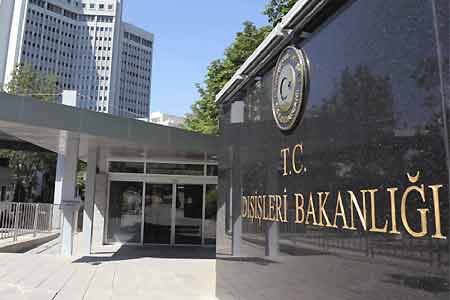 Turkish MFA comments on results of Armenian elections
  Zakharova: International observers cannot ignore `flagrant violations` in Armenian elections