
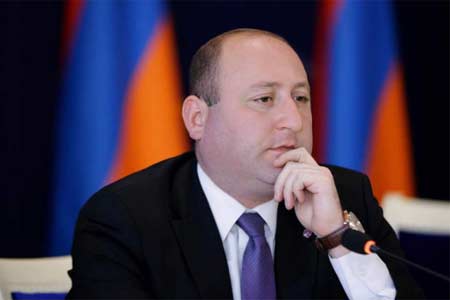
ArmInfo.Americanist Suren Sargsyan presented the key goals of US Secretary of State Marco Rubio's short visit to Yerevan.
In his Facebook post, the expert acknowledged that Rubio's visit to Yerevan certainly had several noteworthy features, and, according to him, it wasn't just that he didn't meet with Armenian Prime Minister Nikol Pashinyan.
In this vein, he touched on the documents signed during the visit.
Regarding the document on strategic minerals, Sargsyan noted that the US and China are in serious competition for mineral resources, especially critical ones. "Washington's main goals in this area are to reduce dependence on Chinese supplies while simultaneously establishing influence in the mining sector in resource-rich countries. To this end, the United States has signed similar agreements with Ukraine, Saudi Arabia, the Democratic Republic of the Congo, Australia, Kazakhstan, and dozens of other countries. Incidentally, one of the justifications for US ambitions regarding Greenland is its mineral wealth, which the Trump administration has repeatedly mentioned," the Americanist noted.
He then touched on the charter on strategic cooperation, noting that from a strategic relations perspective, it is important to understand that the United States classifies diplomatic relations with various countries as follows: allied relations (United Kingdom, Canada), strategic partnership (Vietnam, Kazakhstan), comprehensive strategic partnership (India), comprehensive partnership (Indonesia, Singapore), major non- NATO ally (Israel, Australia), NATO allies, and other friendly countries.
"In this context, it can be said that Armenia has somewhat raised the level of its relations, but, naturally, it cannot speak of allied relations," he noted. Regarding the "Trump Route for International Cooperation and Prosperity" project, Sarkissian noted that the TRIPP factor is important for understanding the current US approach to the South Caucasus. "The US has two main priorities in the region: implementing the TRIPP project and increasing pressure on Iran. An important point regarding TRIPP is often overlooked by the public. It is an important element of US regional strategy, but not the only one. Its goal is to export Central Asian energy resources to Europe through the South Caucasus and Turkey, bypassing China, Russia, and Iran. In fact, China is striving for, and has already partially achieved, greater influence over Central Asian energy resources. It needs reliable export routes to Europe, which could be realized within the framework of the Belt and Road Initiative. The United States, in turn, is seeking to create difficulties for China by limiting its export opportunities using various tools, from sanctions to promoting its own regional projects," he noted.
In other words, he said, while China largely controls Central Asia's energy resources, the United States, driven by competitive logic, is attempting to control potential transit corridors to Europe. "One of the main obstacles to exports from Central Asia to Europe was that delivering resources to Turkey via the Caspian Sea to Azerbaijan required transit through Iran (or more precisely, Georgia), which was not in Washington's interests. In the case of TRIPP, this corridor is provided through Armenia, bypassing Iran, simultaneously bypassing Russia and creating additional complications for China by limiting access to alternative logistics routes. In other words, the Trump administration is very effectively promoting American interests in the South Caucasus, and the Armenian authorities, naturally, are not creating any obstacles for the United States in the face of this global competition and, accordingly, enjoy Washington's support," Sargsyan concluded.























 Analyst: The primary issue with Armenia`s new Parliament Speaker`s speech lies is its one-sided interpretation of the causes of the political crisis
 Expert: Gagik Tsarukyan embodies post-Soviet model of big business-state relations; this model is used in many other post-Soviet countries
 Expert: Azerbaijan promoting aggressive plans against Armenia at state level
 Iranologist: Baku`s propaganda of might masks the country`s inability to provide water to its own population
 NA Vice Speaker candidate believes his wife`s salary as director of HayPost is the lowest in the company`s history
 RF Permanent Representative: There is no CSTO-Armenia conflict
 Moscow: NATO seeking to "Pull" Armenia away from CSTO Allies
  Political analyst: Russia intends to determine which "Camp" Armenia will choose through a referendum
 Narek Karapetyan will give up his parliamentary salary in favor of charitable contributions.
 Armenia and France discuss further development of strategic partnership and EU cooperation
  To overcome risks Armenia must reduce domestic escalation - expert
  Zatulin: Pashinyan was eager to get back to Russia because he actually lost the elections
 Human rights activist Ruben Melikyan dismissed from YSU
 Zakharova: Armenia`s pro-EU pivot poses economic security risks to EAEU member states
 It`s time for South Caucasus countries to think of South Caucasus as single, unified region - RA premier
  Pashinyan: Armenia and Azerbaijan should leave each other alone
 Moscow sees situation with Armenia as attempt to attack Russia-involving integration associations - Russian presidential aid